Tuesday, February 22, 2022

Wednesday prior to Transfiguration


2 Corinthians 4:3-6 – Christians see the glory of God in Jesus

Christians see the glory of God in Jesus - Who is this Jesus? That is the question the world has been asking for close to 2,000 years.  Paul reminds us that by faith we are able to see the glory of God in Jesus Christ. He is more than just a mere man. He is more than just a prophet. He is, as Thomas will confess in the Easter season, “My Lord and My God.”  The world wants Jesus to be anything but God.  A true confession calls for us to say that above anything else He is the Lord of life.

Paul, in discussing the problem of darkness verses light, notes that there will be those to whom the goodness of Jesus Christ is veiled. They will not be able to se, to accept the message of salvation. This is an appropriate selection for the Transfiguration for the event itself suggests an unveiling of Jesus’ ministry in the light of and history of the people of Israel.

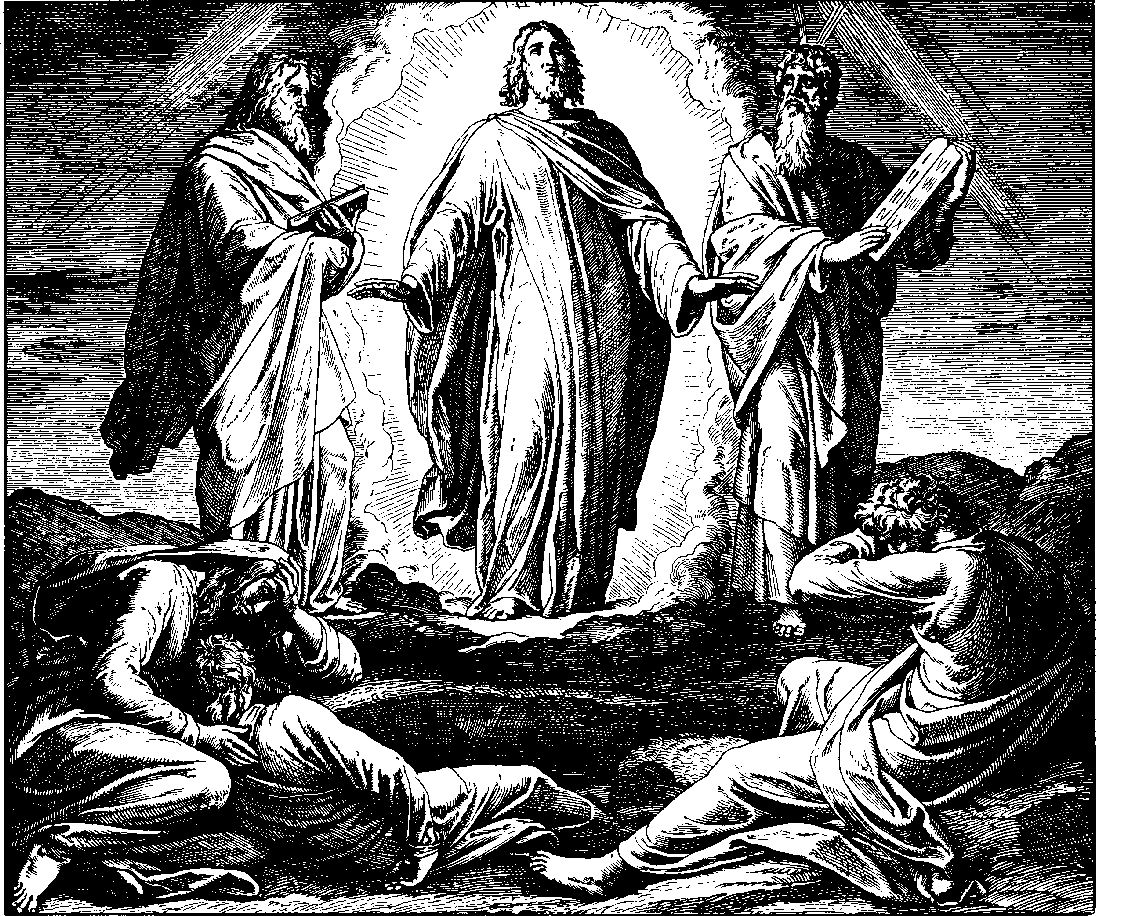
Moses, who appeared with Christ and Elijah on the Mount of Transfiguration, is shown on another mountain in the Old Testament lesson for this week (Deuteronomy 34:1-12), the mountain from which he saw the promised land just before his death. Paul discusses this same Moses in 3:7-16, a section introducing an elaborate parallel between the light on his face and the consequent veil and the light “in the face of Christ” mentioned in 4:6, as well as the veil image of verses 3-4.

Prayer in times of temptation: Almighty and everlasting God, through Your Son You have promised us forgiveness of sins and everlasting life. Govern our hearts by Your Holy Spirit that in our daily need, and especially in all time of temptation, we may seek Your help and, by a true and lively faith in Your Word, obtain all that You have promised; through the same Jesus Christ, our Lord. Amen. [2]– 23 February, 2022


[1] The Transfiguration of our Lord, woodcut by Julius Schnoor von Carolsfeld, a nineteenth-century German artist known especially for his book ‘The Book of Books in Pictures’ ©WELS for personal and congregational use.
[2] A Prayer in times of temptation, Lutheran Service Book © 2006 Concordia Publishing House, St. Louis

Monday, February 21, 2022

Morning Prayer #95


Feeding of 5,000

Matthew 14:13-21


Now when Jesus heard this, he withdrew from there in a boat to a desolate place by himself. But when the crowds heard it, they followed him on foot from the towns. 14 When he went ashore he saw a great crowd, and he had compassion on them and healed their sick. 15 Now when it was evening, the disciples came to him and said, “This is a desolate place, and the day is now over; send the crowds away to go into the villages and buy food for themselves.” 16 But Jesus said, “They need not go away; you give them something to eat.” 17 They said to him, “We have only five loaves here and two fish.” 18 And he said, “Bring them here to me.” 19 Then he ordered the crowds to sit down on the grass, and taking the five loaves and the two fish, he looked up to heaven and said a blessing. Then he broke the loaves and gave them to the disciples, and the disciples gave them to the crowds. 20 And they all ate and were satisfied. And they took up twelve baskets full of the broken pieces left over. 21 And those who ate were about five thousand men, besides women and children.


The Holy Bible, English Standard Version. ESV® Text Edition: 2016. Copyright © 2001 by Crossway Bibles, a publishing ministry of Good News Publishers.


Schnorr Von Carolsfeld woodcuts © WELS permission granted for personal and congregational use


Tuesday prior to Transfiguration


Deuteronomy 34:1-12 - Moses sees God face to face and the promised land- Just before his death; Moses climbs Mount Nebo and from there is shown the Promised Land. He would not be permitted to cross over, but he was able to see it. Moses had faithfully led the people of Israel, and at last his work was done. He had done all he could, his time had come, and it was time for him to cross over to an even greater land than that which his eye beheld.  The Scriptures remind us that Moses’ eye was not dim – he had perfect vision. What secret did Moses possess? Verse 10 gives us a clue. Moses was a man “whom the Lord knew face to face.”  Moses was able to make keen decisions because he kept his eye on God. May that be our legacy, to keep our focus on God.  May that be our vision for our parish, to keep our focus on Christ.

The death and burial of Moses Vv. 1-8 suggests both triumph and defeat. The triumph appears in the first resolve with which Moses goes up the slopes of Mt. Nebo, where he knew that death awaited him., A panoramic views of the land promised to Abraham, Isaac, and Jacob (Exodus 33:1; Deuteronomy 1:8) is possible from this pinnacle. The defeat of the occasion lay in the fact that Moses died without actually entering the land of promise. Moses died at the sentence of God and as a punishment for his sin. (Deuteronomy 43:1)

Verses 9-12 describe the transition in leadership to Joshua and summarize the ministry of Moses. God knew and spoke with Moses face to face. It was to him that God revealed His very name. (“I am who I am”- Exodus 3:14) Moses was partner to great, miraculous signs which God promised and performed in order to liberate Israel from bondage. In a very real way, Moses had the offices of prophet, priest, and king.

This account, in the last chapter of Deuteronomy, is the story of the death of Moses, of whom the writer claims; “…there has not arisen a prophet since in Israel like Moses, whom the Lord knew face to face.” On this celebration of the Transfiguration, Moses in one of the persons who appears with Jesus before his select disciples and so we see and hear in these verses of the great importance of Moses to the tradition and beliefs of the Hebrews.

Prayer for aid against temptation: O God, You justify the ungodly and desire not the death of the sinner. Graciously assist us by Your heavenly aid and evermore shield us with Your protection, that no temptation may separate us from Your love in Christ Jesus, our Lord. Amen. [2]– 2.22.22


[1] The Transfiguration of our Lord, woodcut by Julius Schnoor von Carolsfeld, a nineteenth-century German artist known especially for his book ‘The Book of Books in Pictures’ ©WELS for personal and congregational use.
[2] Collect for aid against temptation, Lutheran Service Book © 2006 Concordia Publishing House, St, Louis

Sunday, February 20, 2022

Morning Prayer #94


An evil and adulterous generation seeks for a sign

Matthew 12: 38-45


Then some of the scribes and Pharisees answered him, saying, “Teacher, we wish to see a sign from you.” 39 But he answered them, “An evil and adulterous generation seeks for a sign, but no sign will be given to it except the sign of the prophet Jonah. 40 For just as Jonah was three days and three nights in the belly of the great fish, so will the Son of Man be three days and three nights in the heart of the earth. 41 The men of Nineveh will rise up at the judgment with this generation and condemn it, for they repented at the preaching of Jonah, and behold, something greater than Jonah is here. 42 The queen of the South will rise up at the judgment with this generation and condemn it, for she came from the ends of the earth to hear the wisdom of Solomon, and behold, something greater than Solomon is here.


Return of an Unclean Spirit


43 “When the unclean spirit has gone out of a person, it passes through waterless places seeking rest, but finds none. 44 Then it says, ‘I will return to my house from which I came.’ And when it comes, it finds the house empty, swept, and put in order. 45 Then it goes and brings with it seven other spirits more evil than itself, and they enter and dwell there, and the last state of that person is worse than the first. So also will it be with this evil generation.


The Holy Bible, English Standard Version. ESV® Text Edition: 2016. Copyright © 2001 by Crossway Bibles, a publishing ministry of Good News Publishers.


Luther's Seal copyright © Edriojas Higher Things  permission granted for personal and congregational use


Morning Prayer #93


Jesus is Lord of the Sabbath 

Matthew 12:1-14

At that time Jesus went through the grainfields on the Sabbath. His disciples were hungry, and they began to pluck heads of grain and to eat. 2 But when the Pharisees saw it, they said to him, “Look, your disciples are doing what is not lawful to do on the Sabbath.” 3 He said to them, “Have you not read what David did when he was hungry, and those who were with him: 4 how he entered the house of God and ate the bread of the Presence, which it was not lawful for him to eat nor for those who were with him, but only for the priests? 5 Or have you not read in the Law how on the Sabbath the priests in the temple profane the Sabbath and are guiltless? 6 I tell you, something greater than the temple is here. 7 And if you had known what this means, ‘I desire mercy, and not sacrifice,’ you would not have

condemned the guiltless. 8 For the Son of Man is lord of the Sabbath.”


A Man with a Withered Hand


9 He went on from there and entered their synagogue. 10 And a man was there with a withered hand. And they asked him, “Is it lawful to heal on the Sabbath?”—so that they might accuse him. 11 He said to them, “Which one of you who has a sheep, if it falls into a pit on the Sabbath, will not take hold of it and lift it out? 12 Of how much more value is a man than a sheep! So it is lawful to do good on the Sabbath.”  13 Then he said to the man, “Stretch out your hand.” And the man stretched it out, and it was restored, healthy like the other. 14 But the Pharisees went out and conspired against him, how to destroy him.


The Holy Bible, English Standard Version. ESV® Text Edition: 2016. Copyright © 2001 by Crossway Bibles, a publishing ministry of Good News Publishers.


Luther's Seal copyright © Ed Riojas Higher Things permission granted for personal and congregational use


Monday prior to Transfiguration


Acts 2:42 - We celebrate the Transfiguration of our Lord on the last Sunday in the season of Epiphany. For our verse for today, I have used to describe what we are trying to accomplish here at Zion. Luke gives us a description of the 1st Century church and this is what is needed as we have entered the 21st Century. We are to be one in doctrine, fellowship, sacramental living, and in prayer. These are the four legs upon which the table is set. All that we do at Friedheim needs to relate to this verse. God has blessed us greatly these past 183 years. Friday of this week we celebrate the 184th anniversary of the signing of our charter.  May He continue to bless us mightily in the years to come.

Moses was faithful in all God’s house as a servant,” but Christ Jesus “has been counted worthy of more glory than Moses” (Hebrews 3:3, 5). A beloved and well-pleasing Son, faithful even to the point of death, Jesus’ own body was raised up on the third day as the house of God, and He has brought us into that house through the waters of Holy Baptism (Hebrews 3:6).

Thus, it was not Moses the lawgiver, but his successor, Joshua (the Hebrew name for Jesus), who led the people into the promised land (Deuteronomy 34:1–4, 9). Now, on the Mount of Transfiguration, the New Testament Joshua appears in the glory that He is about to manifest by His “departure” (exodus) in Jerusalem (Luke 9:31).

Having entered the waters of the Jordan in His Baptism, He passed through those waters and entered into glory by His Cross and Passion.

What He thereby accomplished in His own flesh and blood, crucified and risen, He reveals and gives to His Body, the Church, by the means of His Word. Therefore, the Father declares from heaven, “Listen to Him!” (Luke 9:35).

Collect for Transfiguration: O God, in the glorious transfiguration of Your beloved Son You confirmed the mysteries of the faith by the testimony of Moses and Elijah. In the voice that came from the bright cloud, You wonderfully foreshowed our adoption by grace. Mercifully make us co-heirs with the King in His glory and bring us to fullness of our inheritance in heaven[2].-21 February, 2022


[1] The Transfiguration of our Lord, woodcut by Julius Schnoor von Carolsfeld, a nineteenth-century German artist known especially for his book ‘The Book of Books in Pictures’ ©WELS for personal and congregational use.
[2] Collect for Transfiguration, Lutheran Service Book © 2006 Concordia Publishing House, St. Louis

THE PARABLE OF THE WEDDING FEAST/BANQUET


Matthew 22:1-14

The Parable of the Wedding Feast

And again Jesus spoke to them in parables, saying, “The kingdom of heaven may be compared to a king who gave a wedding feast for his son, 3 and sent his servants to call those who were invited to the wedding feast, but they would not come. Again he sent other servants, saying, ‘Tell those who are invited, “See, I have prepared my dinner, my oxen and my fat calves have been slaughtered, and everything is ready. Come to the wedding feast.”’ But they paid no attention and went off, one to his farm, another to his business, while the rest seized his servants, treated them shamefully, and killed them. The king was angry, and he sent his troops and destroyed those murderers and burned their city. Then he said to his servants, ‘The wedding feast is ready, but those invited were not worthy. Go therefore to the main roads and invite to the wedding feast as many as you find.’  And those servants went out into the roads and gathered all whom they found, both bad and good. So the wedding hall was filled with guests.


“But when the king came in to look at the guests, he saw there a man who had no wedding garment.  And he said to him, ‘Friend, how did you get in here without a wedding garment?’ And he was speechless. Then the king said to the attendants, ‘Bind him hand and foot and cast him into the outer darkness. In that place there will be weeping and gnashing of teeth.’ For many are called, but few are chosen.”[1]


This parable, along with the parables of the two sons and the wicked tenants, should be understood against the background of the final events in Christ’s ministry; Jesus is relating Israel’s shameful treatment of the prophets God sent to call them to repentance. Christ’s hearers were well aware that kings dispatched armies to destroy opponents and to set fire to their cities.

The emphasis in Verses 9-10 is on the mercy God extends to all sinners. Yet each guest must have the proper clothes (Vv. 11-140. The king himself provided the necessary garment. To refuse to wear it is to show contempt for the host. The person who insulted the king, refusing to sit at the banquet on the king’s terms, represents the self-righteous person who rejects the righteousness God offers through Jesus Christ.

Anyone who thinks he does not need the garment of righteousness Jesus secured for him must suffer the consequences.

The point of the parable is that although everyone is welcome at God’s wedding feast, one can be a guest there only on God’s terms. We must therefore take seriously God’s offer of grace. The problem is that we sometimes make God’s gracious offer an excuse for sinning. God invitees all sinners and provides them with the needed garments of salvation.

1.     God invites.

A.    He doesn’t command people to come.

B.     Yet many refuse the invitation.

2.     God invites all.

A.    He sends His messengers out again.

B.     God show no partiality or prejudice. When the respectable people refuse, He invites the lowly and the despise.

3.     God invites on His own terms.

A.    He provides for each guest the needed wedding garment.

B.     While letting Christ’s righteousness cover our sins, we must be on guard lest we continue to love and practice sin.

The LORD Himself has prepared a wedding dinner. What joy to hear “all things are ready!” to hear Him invite you to receive from Him the beautiful garment of Christ’s righteousness.


[1] The Holy Bible, English Standard Version. ESV® Text Edition: 2016. Copyright © 2001 by Crossway Bibles, a publishing ministry of Good News Publishers.