Showing posts with label Pentecost 18. Show all posts

Friday, October 11, 2019

Pentecost 18 - Proper 23


Pentecost 18 – Proper 23
12 October 2019
Luke 17:11-19
How you can be made well


From the Catechism we read, “I believe that God has made me and all creatures; that He has given me my body and soul, eyes, ears, and all my members, my reason and all my senses, and still takes care of them. He also gives me clothing and shoes, food and drink, house and home, wife and children, land, animals, and all I have. He richly and daily provides me with all that I need to support this body and life. He defends me against all danger and guards and protects me from all evil. All this He does only out of fatherly, divine goodness and mercy, without any merit or worthiness in me. For all this it is my duty to thank and praise, serve and obey Him.” [1]

On the way to Jerusalem, on the road that would ultimately lead to His death, Jesus encountered ten pitiable men. He had mercy on them, and, foreshadowing the restoration of all creation at the Last Day, healed them of their dread disease. Only one returned to Jesus to give thanks—a foreigner, the Samaritan.

Christ came into the world to save all people, regardless of ethnicity, skin color, or other outward characteristics. We ought to fall at Jesus’ feet and give thanks for having rescued us from the far more dread disease of sin and its consequences of eternal, and not just temporal, death. 

Jesus – whom Himself was a descendant of a foreign, Moabite woman (Ruth) has made us clean. He Himself is the High Priest who declares us clean to His Father, and gives us a place in His kingdom.

There was no love lost between Jews and Samaritans. Had they been healthy, the nine Jewish lepers would have had had nothing to do with this person whom they considered a half-breed, little better than a heathen. 

But leprosy had made them all outcasts from society, depending on the kindness of strangers in for daily sustenance.

The faith of the Samaritan had grown – for he not only believed in the power of Jesus to heal but he saw Jesus as the only one through whom the Father was working. It was his faith which made him whole. Our text answers a basic question of faith – how you can be made well.

1. What are you are saved from – ingratitude.

A.      In a word we call this selfishness.

1. We live in a world where everything seems to be centered on self. We’ve been trained by our culture to believe in ourselves. Not only do we want to be wealthy and famous, we’ve been oriented to feel we deserve it.

2. This focus on self leads some to become self-serving and spoiled. Thinking they should get whatever they want, they will torment anyone who doesn’t give into their demands. Thus, a man all wrapped up in himself becomes quite a small package.

B.      Taking things for granted.

1. Possibly we’re so focused on self because we’ve never had it so good. What is there that is lacking in our lives? Do we not live in the lap of luxury?We’re comfortable. And yet there are persons living in misery - feeling unfulfilled, frustrated, disgruntled, angry. 

2.  We don’t know how good we’ve had it until it is taken away from us. We do not know how these men lived before leprosy became their lot. But we do know what they had become –exiles, untouchable, shipwrecked. 

C.     Negativism.

1. Blessings are not a guarantee. No one is immune. Do we count our blessings or our problems?  Have we grown to expect them?

2. Negativism can possibly be a result of being spoiled.“A selfish man is a thief.” [2}  He will steal your heart, your money and your livelihood if you let them.

Transition: We have been saved from ingratitude – yet as we count our blessings we return thanks to the Savior.

2. What we are saved for – gratitude.

A. Counting you blessings. “One of them, when he saw he was healed, came back, praise God in a loud voice.” Vs. 15 The lepers left for the temple and to the priest because Jesus had commandment them to do so. The Samaritan returned. To give thanks to Jesus. He did this because of His faith. Faith always responds with gratitude. That is how you respond. With gratitude and thanks, and a grateful heart.

1. God has blessed us in so many ways. Look around you. Everything is a gift. Consider the open hand of your Merciful Master.  “Forgiveness, life, salvation.” These three come from your heavenly Father. How do you respond? “For all this it is my duty to thank and praise, serve and obey Him.”

2. His mercies cannot be counted. Says the Psalmist: “You have multiplied, O LORD my God, your wondrous deeds and your thoughts toward us; none can compare with you! I will proclaim and tell of them, yet they are more than can be told.” Psalm 40:5

B. Recognizing God as the healer. The lepers cried, “Jesus, Master, have pity on us!” Vs. 12 Which moved the hymn writer to inscribe these words, “Other refuge have I none; hangs my helpless soul on thee; leave, ah! leave me not alone, still support and comfort me. All my trust on thee is stayed, all my help from thee I bring; cover my defenseless head with the shadow of thy wing.”  [3]

1. Lepers had to follow a specific prescription – after being quarantined they had to report to the priest. Before they even arrived at the temple behold they were cleansed. The priest’s inspection would verify they were whole. 

2. God still works through means. The doctor might hand us the bill but it is the Savior who heals. Christ not only died for all. He died for each.

C. Praising God for His goodness “he came back, praising God in a loud voice.” Vs. 15b Says the Psalmist in Psalm 107:8-9, "Let them give thanks to the LORD for his unfailing love and his wonderful deeds for men, for he satisfies the thirsty and fills the hungry with good things.”

1. He heals our diseases. When Jesus says, “Go!” That’s a complete sentence. It is one thing to feel grateful; it is another thing to express it. The louder you called for help, all the louder you should praise God. The Greek word used to describe his giving thanks εὐχαριστῶ is the word that is translated as Eucharist. The Eucharist is public thanks! Jesus is the true healer. Live your lives in perpetual thanksgiving and praise. At His table. And in your life.

2. Christ forgives our many sins. And it is the message of the cross which tells us that God understands our sin and our suffering, for He took them upon himself in the Person of Jesus Christ. From the cross God declares, 'I love you. I know the heartaches and the sorrows and the pain that you feel. But I love you.'

With that lone leaper we can say, for all our Your tender mercies Lord, we give You thanks and praise.
___________
Words – 1,220
Passive Sentences – 11%
Readability – 80.3%
Reading Level – 4.7

Footnotes
1. Luther's Small Catechism "Explanation of the First Article" copyright © 2006 Concordia Publishing House, St. Louis
2. The famous Cuban poet Jose Marti 
3. Jesus, Lover of my Soul, stanza two copyright © 1942 The Lutheran Hymnal, Concordia Publishing House, St. Louis

Sunday, October 6, 2019

Time in the Word - Proper 23


Time in the Word 
Preparation for
Pentecost 18 – Proper 23
October 7 – 12, 2019

Faith Returns Thanks to God and Worships Him in the Person of Christ Jesus

Jesus comes in mercy, and by His Word heals you in body and soul. “Go and show yourselves to the priests,” for you are cleansed (Luke 17:14), and you are granted access to the Lord’s Temple. It is “at Jesus’ feet, giving Him thanks” (Luke 17:16), that you worship God, for Christ Jesus is your great High Priest; His Body is the true Temple. In Him you “find rest, each of you in the house of her husband” (Ruth 1:9), for the Lord has “visited His people and given them food” (Ruth 1:6). The person of Jesus Christ lodges Himself in holy food—bread and wine for believers to eat and drink. You lodge where Jesus lodges; His Father is your God, His people are your people. Death cannot part you from Him, because His death and resurrection are eternally yours through Holy Baptism. “Remember Jesus Christ, risen from the dead” (2 Tim. 2:8–9). As surely as death could not hold Him, so surely “the Word of God is not bound” (2 Tim. 2:9). His Gospel is entrusted “to faithful men who will be able to teach others also” (2 Tim. 2:2), so that you “may obtain the salvation that is in Christ Jesus” (2 Tim. 2:10). Such is the confession of faith for all the saints, who believe, teach, and confess the one Lord and Savior—Jesus Christ.

Collect for the Eighteenth Sunday after Pentecost: Keep, we pray You, O Lord, Your Church with Your perpetual mercy; because without You we cannot but fall, keep us ever by Your help from all things hurtful, and lead us to all things profitable for our salvation; through Jesus Christ, Your Son, our Lord, who lives and reigns with You and the Holy Spirit, one God, now and forever. Amen.

Prayer for the sick: O Father of mercies and God of all comfort, our only help in time of need, look with favor upon Your servant. Assure him/her of Your mercy, deliver him/her from the temptations of the evil one, and give him/her patience and comfort in his/her illness. If it please You, restore him/her to health, or give him/her grace to accept this tribulation with courage and hope; through Jesus Christ, our Lord. Amen.

Prayer for deliverance from sin: We implore You, O Lord, in Your kindness to show us Your great mercy that we may be set free from our sins and rescued from the punishments that we rightfully deserve; through Jesus Christ, our Lord. Amen.

Prayer for agriculture: Almighty God, You bless the earth to make it fruitful, bringing forth in abundance whatever is needed for the support of our lives. Prosper the work of farmers and all those who labor to bring food to our table. Grant them seasonable weather that they may gather in the fruits of the earth in abundance and proclaim Your goodness with thanksgiving; through Jesus Christ, our Lord. Amen.


Morning Prayer Readings for this coming week:
October 07 Golden Calf - Exodus 32
October 08 Spies - Number 13, 14
October 09 Chapel
October 10 Into Cannan - Deuteronomy 34- Joshua 3
October 11 1st Conquest - Joshua 6

Catechism Review: 1st Article of the Apostles’ Creed


Prayers from Lutheran Service Book © 2006 Concordia Publishing House.
Luther’s Seal © Ed Rajas Higher Things

Monday, 07 October 2019Psalm 34:2–4, 17; antiphon, Psalm 48:1—The Introit calls upon us to praise the Lord for His deliverance of His righteous ones out of all their troubles. Who are the righteous? We learned in the Old Testament reading from last week that those who place their trust in the Lord are the ones who are righteous—by their faith.

Tuesday, 08 October 2019Psalm 111—Psalm 111 is a song of high praise to the LORD for His many and continued blessings upon His people—physical and spiritual blessings. The LORD’s great works and His provision of food are recounted before the His greatest blessing is extolled: He sent redemption to his people. In the face of the mighty deeds, awesome power, and goodness of the Lord, the psalmist concludes, The fear of the LORD is the beginning of wisdom; all those who practice it have a good understanding. His praise endures forever!

Wednesday, 09 October 2019Ruth 1:1–19a—Sunday’s Old Testament reading is the opening portion of the book of Ruth. Ruth was not an Israelite, but a Moabite woman, whose husband had died. During a famine, Ruth’s husband died, as did his brother. When Naomi, the brothers’ mother, planned to go to Bethlehem, because she had heard there was food there, she urged her daughters-in-law to remain in Moab where, as still-young women, they might find husbands. Orpah did, but Ruth remained with Naomi, resolutely declaring, “Where you go I will go, and where you lodge I will lodge. Your people shall be my people, and your God my God.” This strong foreign woman, who took the Lord GOD of Israel—the true God—as her own God, would become an ancestress to the Christ, the incarnate Son of the only true God (Matthew 1:5

Thursday, 10 October 20192 Timothy 2:1–13—Our reading through Paul’s second letter to Timothy continues with encouragement to remain a good soldier of Christ Jesus, even in the face of suffering. But, this is no advice to Timothy simply to look deep inside himself for strength, or keep a stiff upper lip. 

No, the Christian’s source of strength in the midst of adversity always comes from the fact that we are strengthened by the grace that is in Christ Jesus (v. 1). Paul then quotes what he had written in his epistle to the Romans, in connection with Holy Baptism: If we have died with him, we will also live with him. Our Baptism into Christ gives us strength daily to face whatever hardships we may face in this life.

Friday, 11 October 2019Luke 17:11–19—There was no love lost between Jews and Samaritans. Had they been healthy, the nine Jewish lepers would have had had nothing to do with this person whom they considered a half-breed, little better than a heathen. But leprosy had made them all outcasts from society, depending on the kindness of strangers in for daily sustenance.

On the way to Jerusalem, on the road that would ultimately lead to His death, Jesus encountered these ten pitiable men. He had mercy on them, and, foreshadowing the restoration of all creation at the Last Day, healed them of their dread disease. Only one returned to Jesus to give thanks—a foreigner, the Samaritan.

Christ came into the world to save all people, regardless of ethnicity, skin color, or other outward characteristics. We Gentiles, too, ought to fall at Jesus’ feet and give thanks for having rescued us from the far more dread disease of sin and its consequences of eternal, and not just temporal, death. This Descendant of a foreign, Moabite woman has made us clean. He Himself is the High Priest who declares us clean to His Father, and gives us a place in His kingdom. This Gospel lesson will be read on Thanksgiving Day. 

Saturday, 12 October 2019—Sunday’s Hymn of the Day is Your Hand, O Lord, in Days of Old (LSB #846). It also makes the connection between Christ healing disease and infirmities of the body when he walked the earth and His redemptive work in cleansing us from our sins. The last stanza asks that we, too, may be delivered from the sickness of sin, that we might offer up our praise and thanksgiving, as the Samaritan did in the Gospel reading.

Sunday, October 1, 2017

Time in the Word - Pentecost 18 ~ Proper 22


A Study for Proper 22
October 2-7, 2017
The Vineyard of God’s People

In the Lessons for this week, we look at evil confidences, which cannot stand under the light of God’s Holy Law. God’s people constitute a vineyard. The Gospel and Old Testament lessons complement each other in the use of a vineyard as a metaphor for God’s people. In both, the vineyard is at fault; in the Gospel, the tenants refuse to render fruit; in the Old Testament, the fruit is wild. In the Epistle lesson, the wild fruit are those who are “enemies of the cross of Christ” and serve as an example of the right kind of fruit Christians produce. Because God’s vineyard is His people, He has the right to ask for proper returns from the vineyard. Both the Old Testament lesson and the Gospel pronounce judgment upon the vineyard for failing to produce the fruit of acknowledging Christ as Lord and the fruit of justice. 

Collects for Proper 22Gracious God, You gave Your Son into the hands of sinful men, who killed Him. Forgive us when we reject Your unfailing love, and grant us the fullness of Your salvation; through Jesus Christ, Your Son, our Lord, who lives and reigns with You and the Holy Spirit, one god, now and forever

O God, whose almighty power is made known chiefly in showing mercy and pity, grant us the fullness of Your grace that we may be partakers of Your heavenly treasures.

A prayer for AgricultureYou bless the earth to make it fruitful, bring forth in abundance whatever is needed for the support of our lives. Prosper; we pray the work of farmers as they bring food to our table. Grant them seasonable weather that they may gather in the fruit of the earth, and thus proclaim Your goodness with thanksgiving. Cause all people who give thanks over their food to treat those who produce it with honor and respect. May we see by this noble vocation that through them You feed the world.

A prayer before we study the WordAlmighty God, our heavenly Father, without Your help, our labor is useless, and without Your light, our search is in vain. Invigorate the study of Your holy Word that, by due diligence and right discernment, we may establish ourselves and others in Your holy faith.

Monday, October 2, 2017Psalm 118:22-24 - Antiphon, verse 1:“O Give thanks to the Lord for He is good; for His steadfast love endures forever.” – This is a call to praise the Lord. David offers a song of thanksgiving for deliverance and victory. The people rejoice over what the Lord has done. Thereafter, the king speaks his final word of praise (see verse 28). We praise and exalt the Lord because He is mighty to save. This is why He is good – His mercy, His steadfast love endures forever.

Tuesday, October 3, 2017Psalm 80:7-19 – This week’s Psalm has as the key verse, verse 7. The vineyard of the Lord of hosts is Israel, and the men of Judah are the plant He cherished (Isaiah 5:7). After making a lament over the Lord’s severe punishment of His people the Psalmist looks to the Lord who will vindicate His own as He restores and makes His face shine upon them that they might be saved. 

Wednesday, October 4, 2017Isaiah 5:1-7 - God’s people receive judgment for evil fruit.  Confidence in violence and bloodshed leads to judgment. In the Old Testament reading, God’s judgment upon His people is shown for their failure to produce proper fruit. The prophet sings a love song to God regarding God’s vineyard, his people. God is his “beloved.” God loves His people. Proof of this love is that God’s vineyard, His possession, is His people. Out of love, God accepts and owns His people. And look what God has done for His people! He has placed a vineyard on a fertile hill. He dug the ground, cleared away the stones, and planted it with the best vines. Then He built a watchtower and a wine vat. God is love and He deals lovingly with His people: claiming them as His own, and providing for them by giving them the best of everything to be fruitful.

Thursday, October 5, 2017Philippians 3:4b-14 – God’s people strive to be examples worthy of Christ. Confidence in the flesh cannot stand. Forgetting the past, Paul presses on toward the goal of Christ and lives as an example for others. Paul defends himself as a Christian of the first order through the mercies of God. Yet, he does not think he has it “made,” but keeps striving for complete devotion to Christ by becoming one in the sufferings, death, and resurrection of Christ. Because he imitates Christ, he is able to ask his people to imitate him in both faith and life. 

Though we are in the world, we belong to the kingdom of heaven. When Christ returns, He will transform our earthly bodies to spiritual bodies.

Paul uses this phrase “I press on” twice in this passage. It must have been important to him in getting across his plan. He is not idly waiting for perfection to come to him. He is not neutral. He is urgent, pursuing, and energetic in getting to his goal. To become like Christ is a process over a lifetime — ever striving to be like Christ in every area of life. At the same time, Paul would say that God was in him pressing on, working in him. A Christian dare not be content with his life. He is ever seeking to improve it.

Friday, October 6, 2017Matthew 21:33-46 – God’s people refuse to return God His due. Confidence in one’s own faith will fail. This is another parable of the kingdom.  The vineyard is Israel. The tenants are the religious leaders. The servants are the prophets. The son is Jesus. The murder was the cross. Jesus is saying that time after time God has sought to redeem his people through the prophets, but each effort was in vain. In desperation, He sent His Son whom they crucified. This is in accord with the psalmist who says the rejected stone became the cornerstone. The outcome of it is that the religious leaders of Israel will lose the kingdom, which will be given to those who produce the fruit of righteousness. Because of their rejection of Christ, the Jews lost, but the Gentiles gained the kingdom.

The owner has a right to receive fruit from the tenants. People owe something to God. Time after time God comes for His due until finally He makes the ultimate appeal in His Son, Jesus. Rebellious tenants kill the Son in hope of taking over the vineyard. Here can be seen the patience of God, trying repeatedly to get the tenants to respond; here can also be seen the greed of people.

Saturday, October 7, 2017Matthew 25:1-13 - Our reading is the inspiration for the hymn, “Rejoice, Rejoice Believers.” The believer rejoices only in Christ. The days are getting shorter, soon the harvest will commence. We pray for the safety of all who work to bring food to our table. We also anticipate a harvest of souls. 

Sources:
Lutheran Service Book Concordia Publishing House, St. Louis MO © 2006
Lutheran Worship Concordia Publishing House, St. Louis MO © 1980 pg. 83
Lectionary Preaching Workbook Series A by John Brokhoff © 1980 CSS Publishing Lima OH pg. 253
Image © Ed Rojas  Higher Things 


Saturday, October 15, 2011

Pentecost 18 - Proper 24


Proper 24 (16–22 October)
O God, the protector of all who trust in You, have mercy on us that, with You as our ruler and guide, we may so pass through things temporal that we lose not the things eternal; through Jesus Christ, Your Son, our Lord, who lives and reigns with You and the Holy Spirit, one God, now and forever.

Honor bestowed – Paying taxes to Caesar - Matthew 22:15-22

Religious leaders attempt to trap Jesus by asking him whether taxes should be paid to Rome. The religious leaders came to Jesus with a trick question that no matter how He answers, He is in trouble. Pharisees and Herodians come to Him with the question whether taxes should be paid to the Roman government. The Pharisees would say, “No”; the Herodians would answer, “Yes.” If Jesus said one should not pay taxes, He could be arrested as a subversive and revolutionary. If Jesus said one should, He would be in trouble with the patriotic Jews who hated Roman dominance. Jesus recognized that the inquirers were hypocrites and that they came to find occasion to have Him arrested. His answer caused His enemies to marvel at His answer: “Render to Caesar the things that are Caesar’s, and to God the things that are God’s.”

There may be a separation of church and state, but not separation of God and state. This is implied in Jesus’ statement that we are to render to Caesar and to God, not to one or the other. Trouble begins for a nation when it separates itself from God. The sermon can show how God and state are interdependent interrelated. How God and state are related.

A. God is the Lord of the nation — “Blessed is the nation whose God is the Lord.”
B. The laws of the state reflect the laws of God. The state is the left hand of God’s justice.
C. The ministers of state are also ministers of God.

So how ought we approach this sometimes difficult subject? Do religion and politics mix? We have the obligation to be witnesses in the world. As Christians we certainly have a message the world needs to hear and what is more relevant to a lost world than the objective truth of the gospel? By these words of our Savior we must say that all obligations are to God as they are expressed in two kingdoms.

The Pharisees as a group were fiercely loyal to the Jews, who hated the Romans. The Herodians on the other hand - were fiercely loyal to Rome which ruled the Jews with great difficulty. They come to Jesus with a question.

The Pharisees had hoped to trap Jesus in his teaching. If Jesus said it was unlawful to give tribute to Caesar, the Herodians would have him brought to court on a charge of sedition, a crime punishable by death. If Jesus said it was lawful to pay tribute to Caesar, the Herodians would have advertised this and used it as an opportunity to diminish Jesus’ popularity before those persons who labored under the yoke of the Roman government (and wished to be freed). But Jesus refused to be trapped. And His answer gives mankind direction in living for all ages of the world.

I. THE KINGDOM OF THIS WORLD IS OF GOD AND DEMANDS MY OBLIGATIONS

A. The kingdom of this world is of God. Jesus uses the word "Caesar" to symbolize the power of the government. In the history of the world there have been many different forms of government but all are of God. Jesus said to Pilate a Roman Governor

[1] "You would have no authority over Me if it had not been given to you from above." (John. 19:11.) The God-man, Jesus, was subject to the earthly authority which He had given to Pilate. St. Paul says in Romans 13:1: "Let every person be subject to higher authorities because there is no authority which is not of God and the authorities which exist have been ordained of God."

[2] God Himself has given us an earthly government. Daniel acknowledged the Babylonians as his government. Jesus and Paul recognized Rome as their God-given government.

B. The kingdom of this world demands my obligations. Jesus told the Pharisees and the Herodians: "Pay to Caesar what you owe to Caesar." What did they owe to Caesar? We owe taxes, obedience to all laws, and loyalty to the government. That is what Jesus himself, Paul and Peter did. In Matthew 17:24-27 Jesus gives us the correct attitude toward earthly power. He directed Peter to catch a fish which would yield a coin with which Peter would pay their tax. And Jesus obeyed all laws whether of the Jews or Romans. He submitted both to Pilate and Herod at His trial even though it was an unjust trial. And the apostles direct us to willing obedience toward our government.

Says St. Paul – “Everyone must submit himself to the governing authorities, for there is no authority except that which God has established. The authorities that exist have been established by God. Consequently, he who rebels against the authority is rebelling against what God has instituted, and those who do so will bring judgment on themselves. For rulers hold no terror for those who do right, but for those who do wrong. Do you want to be free from fear of the one in authority? Then do what is right and he will commend you. For he is God's servant to do you good. But if you do wrong, be afraid, for he does not bear the sword for nothing. He is God's servant, an agent of wrath to bring punishment on the wrongdoer. Therefore, it is necessary to submit to the authorities, not only because of possible punishment but also because of conscience. This is also why you pay taxes, for the authorities are God's servants, who give their full time to governing.” Romans 13:1-6

Peter reminds us -– "Submit yourselves to every ordinance of man for the Lord's sake: whether it be to the king, as supreme; Or unto governors, as unto them that are sent by him for the punishment of evildoers, and for the praise of them that do well.
For so is the will of God, that with well doing ye may put to silence the ignorance of foolish men:
" I Peter 2:13-16

TRANSITION: The Kingdom of this world is of God so also is the Kingdom of God to which I am obligated.

II. THE KINGDOM OF GOD IS OF GOD AND DEMANDS MY OBLIGATIONS

A. The kingdom of God is of God. Jesus said to the Pharisees and Herodians: "Pay to God the things of God." Jesus said in Matthew16:18: "You are Peter and on this rock I will build My church and the gates of hell will not prevail against it. I will give you the keys of the kingdom of heaven. Whatever you bind on earth will be bound in Heaven. Whatever you loose on earth will be loosed in heaven." In this passage the word "rock" means Peter's confession of Christ. Christ builds His church on the confession of Jesus Christ and Him crucified. And even Satan and his hosts cannot destroy this church. To this church Christ gives the power to forgive sins to penitent sinners and to withhold forgiveness from sinners who refuse to repent.

B. The kingdom of God demands my obligations. Christ is our Shepherd. His pastors are also called shepherds. They are to take good care of the flock.[3] And when the Pharisees and Herodians came to Jesus, Jesus asked for a denarius, a common coin in that day. We use our money to support the government and the church. We pay our taxes and we pay our church dues. Both are commanded by God. Says St. Paul in Romans 13 – “This is also why you pay taxes, for the authorities are God's servants, who give their full time to governing. Give everyone what you owe him: If you owe taxes, pay taxes; if revenue, then revenue; if respect, then respect; if honor, then honor. (Vv.6-7) And again in 1 Corinthians 16 “On the first day of every week, each one of you should set aside a sum of money in keeping with his income, saving it up, so that when I come no collections will have to be made.” (V.2) Paul told the people to pay their taxes and also their church dues. All of this belongs to God. We are only stewards of His gifts.

CONCLUSION I am a citizen in two kingdoms, the kingdom of earthly power, my government, and the kingdom of God, my church. I owe each everything I have. It all is a gift of God and belongs to Him anyway. Christians are sojourners and pilgrims in this world (I Peter 2:11). While our true citizenship is in heaven (Philippians 3:20), we are to be ever mindful of our responsibilities to the nation in which we live. As we love God and serve our neighbor we are witnesses of Him in this world. That, my friends is the definition of missions – Love God, serve your neighbor – become a sermon in shoes.

Sunday, October 9, 2011

Pentecost 18 - Proper 24 - Time in the Word


We Are Recreated in the Image of God by the Cross of Christ

Plotting against Jesus, the Pharisees attempted “to entangle Him in His talk” by asking about the payment of taxes to Caesar (Matt. 22:15). The Lord pointed to coins required for the tax, and He answered that we should “render to Caesar the things that are Caesar’s, and to God the things that are God’s” (Matt. 22:21). But if coins bearing the image of Caesar should be rendered to him, then man—who is made in the image of God—must be rendered to the Lord. That tax is paid for us by the Lord Jesus, the Image of God in the flesh, by His self-offering on the Cross. And from His Cross, as the Lord’s Anointed, He reigns as the true Caesar over all nations “from the rising of the sun and from the west” (Is. 45:6). The Lord once called and anointed Cyrus “to subdue nations before him and to loose the belts of kings” (Is. 45:1). Now by the preaching of the Gospel, “in power and in the Holy Spirit” (1 Thess. 1:4), foreigners from all over the world are “turned to God from idols to serve the living and true God” (1 Thess. 1:9–10).


Collect for the Seventeenth Sunday after Pentecost: O God, the protector of all who trust in You, have mercy on us that with You as our ruler and guide we may so pass through things temporal that we lose not the things eternal; through Jesus Christ, Your Son, our Lord, who lives and reigns with You and the Holy Spirit, one God, now and forever.

Prayer for good government: Eternal Lord, ruler of all, graciously regard those who have been set in positions of authority among us that, guided by Your Spirit, they may be high in purpose, wise in counsel, firm in good resolution, and unwavering in duty, that under them we may be governed quietly and peaceably; through Jesus Christ, Your Son, our Lord, who lives and reigns . . .

Prayer for the nation: Almighty God, You have given us this good land as our heritage. Grant that we remember Your generosity and constantly do Your will. Bless our land with honest industry, truthful education, and an honorable way of life. Save us from violence, discord, and confusion, from pride and arrogance, and from every evil course of action. Grant that we, who came from many nations with many different languages, may become a united people. Support us in defending our liberties, and give those to whom we have entrusted the authority of government the spirit of wisdom, that there may be justice and peace in our land. When times are prosperous, may our hearts be thankful, and in troubled times do not let our trust in You fail; through Jesus Christ, Your Son, our Lord, who lives and reigns . . .

Prayer for responsible leaders: O merciful Father in heaven, from You comes all rule and authority over the nations of the world for the punishment of evildoers and for the praise of those who do well. Grciously regard Your servants, those who make, administer, and judge the laws of this nation, and look in mercy upon all the rulers of the earth. Grant that all who receive the sword as Your servants may bear it according to Your command. Enlighten and defend them, and grant them wisdom and understanding that under their peaceable governance Your people may be guarded and directed in righteousness, quietness, and unity. Protect and prolong their lives that we with them may show forth the praise of Your name; through Jesus Christ, Your Son, our Lord, who lives and reigns . . .

Monday, 10 October 2011Psalm 121:1–4, 7–8; Antiphon, Psalm 121:5Psalm 121 is a Song of Ascents; it was sung by pilgrims making their way up to the holy city of Jerusalem for the celebrations of the great feasts and festivals. It speaks of the help and assistance rendered by the Lord to His people. The first verse is a bit surprising: for people who had to travel great distances from home on foot, hills were often dangerous places, where thieves or wild animals could hide, lying in wait for unwary travelers. But here, the hills refer to the hills surrounding Jerusalem, the place where God dwelt with His people in the temple. It is from Him that our help comes, it is the Lord who watches over us.

Tuesday, 11 October 2011Psalm 96:1–9All the peoples of the earth are called to sing to the Lord, because he has provided salvation for the whole world. Christ won peace and forgiveness not only for Israel but for all people. Since Christ died for all the world, God’s people are to proclaim the message of salvation to the whole world. (People’s Bible)

Wednesday, 12 October 2011Isaiah 45:1–7Isaiah was sent by God in the eighth century b.c. to prophesy to the nation of Judah (the southern kingdom), warning them to repent of their wicked ways, lest they suffer the same fate as their northern brethren, who had been carried off into captivity by the Assyrians. In 586 b.c., the Babylonians fulfilled God’s decree. But Isaiah also prophesied that God would send someone to deliver them from the Babylonians and allow them to return to their homeland. This one was Cyrus, the Persian king. This portion of Isaiah speaks of him. Astoundingly, though Cyrus was a pagan, God calls him His ‘anointed’. Though this term was usually reserved for Israelites who were consecrated as priests, prophets, and kings, this foreign heathen would become the instrument of God to deliver His people. Likewise, in our day, God works, even through godless regimes and governments to take care of Hos people, even when we cannot understand His methods and reasons.

Thursday, 13 October 20111 Thessalonians 1:1–10In this last portion of the Church Year, the epistle readings are drawn from St Paul’s letter to the church at Thessalonica in Greece. The congregation had been established by Paul whilst on his second missionary journey. All of Paul’s work in the region of Macedonia was marked by severe persecution; the congregation at Thessalonica faced fierce opposition from Jews. When he got to Athens, Paul sent Timothy back to Thessalonica to strengthen the fledgling congregation and to bring a report. The report cheered Paul’s heart, as it told him that, more than just withstanding persecution, the congregation was actively spreading the Gospel throughout Macedonia. The first half of the letter (through 3:9), therefore, expresses his love, thankfulness, and concern for the Christians at Thessalonica.

Friday, 14 October 2011Matthew 22:15–22We Americans often have an adversarial relationship with the civil authorities. We worry about what the government is going to do to us, rather than for us. We may be tempted to withhold what we rightly owe, thinking that they won’t spend it correctly, or that they don’t deserve so much. But Jesus councils us to pay the taxes we owe, but also drawing a line of demarcation between the government and God. There is rightly a separation of Church and State. We do not want the civil government interfering in the affairs of the Church; neither should the Church interfere in matters of state.

Saturday, 15 October 2011As the psalm for the day calls upon all peoples of the earth to praise the Lord, so, too, the hymn of the day, Holy God, We Praise Thy Name (LSB #940), calls upon every creature, on earth and in heaven, to join in the chorus.


Lectionary summary on front page from LCMS Commission on Worship
Artwork by Ed Riojas, ©Higher Things
Prayers from Lutheran Service Book © 2006 Concordia Publishing House

This week's Time in the Word written by Pr. Jeffrey Keuning 

Saturday, September 25, 2010

Pentecost 18 - Proper 21

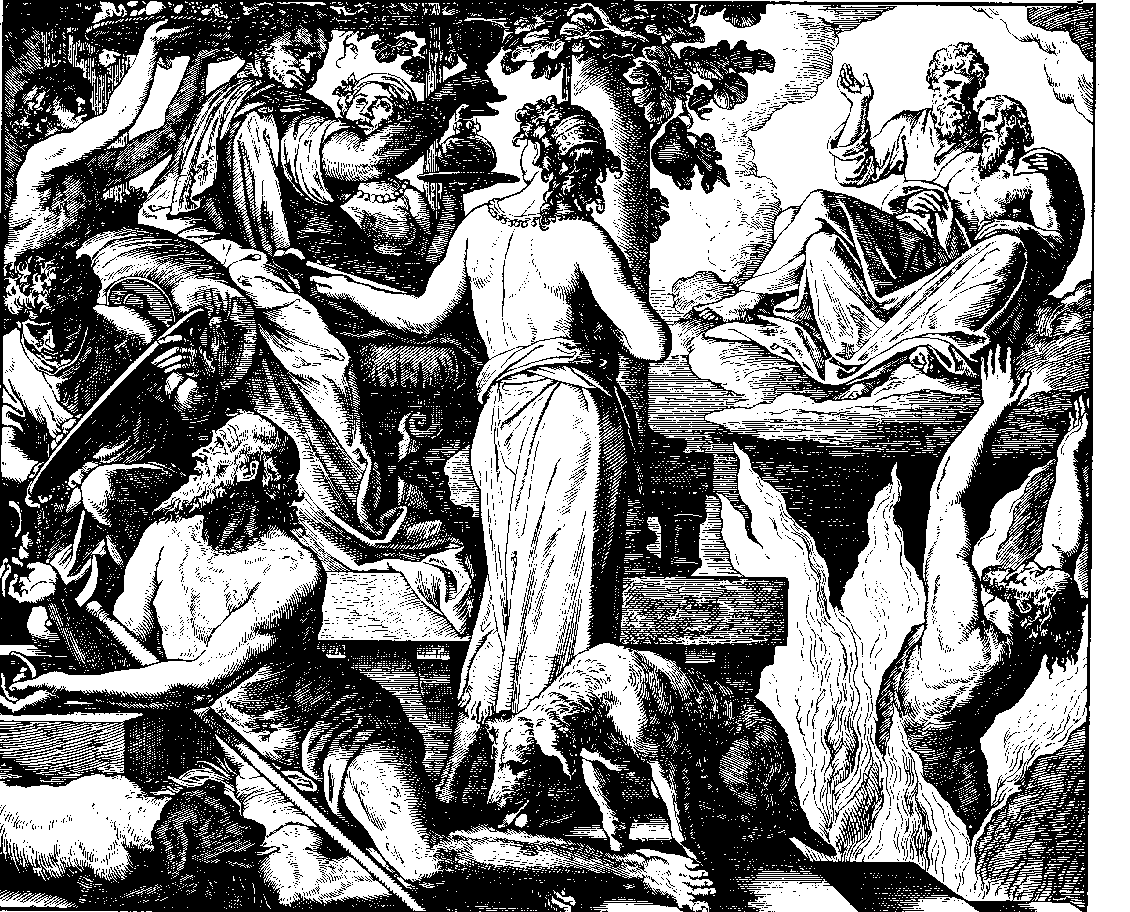
Luke 16:19-31
Concern about the Unconcerned
The root of the problem in our parable is how to get people like the rich man to be concerned about the hungry, sick, and the poor. The facts are all there. Some have more than they need. Others have only poverty. How can we get the rich to share with the poor? It does little good to describe the rich man’s wealth and poor man’s plight. It is all clear to us. The question asked of us is this where is your compassion? How do you get concerned?

1. Fear the consequences of not caring – Vv. 22-24 - The time came when the beggar died and the angels carried him to Abraham’s side. The rich man also died and was buried. In hell, where he was in torment, he looked up and saw Abraham far away, with Lazarus by his side. So he called to him, ‘Father Abraham, have pity on me and send Lazarus to dip the tip of his finger in water and cool my tongue, because I am in agony in this fire.’

See also Amos 6:7 Therefore you will be among the first to go into exile; your feasting and lounging will end.

We in America have never had it so good. Compared with the rest of the world we are the envy of the world. Eight words sum up this nation’s blessings, “America, America, God shed His grace of thee…

Even the poorest Americans have it better then most 3rd world countries. People from almost every conceivable country are trying to get into our nation legally and illegally. America remains the land of plenty. How do we react to our wealth? Are we grateful? Do we return in kind? Do we bless others as we have been blessed?

2. Love for brothers and sisters – V. 28 for I have five brothers. Let him warn them, so that they will not also come to this place of torment.

Consider all as brothers and sisters, especially those in need. Is it just if, in the world’s family, 3 are overfed and 5 are hungry? There is a spiritual aspect to the vocation of farming. We mention this in our prayers. “By this noble vocation we feed the world.” This is true. Where would this world be without the American farmer?

Do you see the end result of all of your labors? Once you sell your grain what happens to it? It is used to feed another portion of the world. This is why we end our petition with the phrase, “and cause all people who give thanks over their food to treat those who produce it with honor and respect.”

3. Have a father-son/daughter relationship – Vv. 24-25 So he called to him, ‘Father Abraham, have pity on me and send Lazarus to dip the tip of his finger in water and cool my tongue, because I am in agony in this fire.’ “But Abraham replied, ‘Son, remember that in your lifetime you received your good things, while Lazarus received bad things, but now he is comforted here and you are in agony.

The rich man refers to Abraham as his father and Abraham calls the rich man “son.” If God is our Father we are His children. It is the Father’s will that we care for the other members of His family. This refers to the relationships we have within our own families, within our Friedheim family as well as those relationships we have with others at work, at school, and in the world. We are compelled to reach out to others with the love and compassion of Christ.


4. Hear the Word – V. 31He said to him, ‘If they do not listen to Moses and the Prophets, they will not be convinced even if someone rises from the dead.’

The Word of God, the Bible – Law and Prophets – and the Incarnate Word in Jesus teach us to love one another by caring and sharing. But especially do we heed the Incarnate Word in Jesus. This is the only message we have. The world has no other. If our lives are to be changed, if we are to impact the lives of others there is no other source, there is no other tool we have expect for the inspired, infallible, inerrant, Word of our Lord.

Lord, teach us to love one another by caring and sharing. Use me to be an instrument of Your love in the life of someone this week.

Sunday, September 19, 2010

Time in the Word - Pentecost 18 - Proper 21


Concerned Christians
The lessons give us a picture of people in luxury, affluence, and leisure but without concern for the less fortunate. In the Gospel, the rich man (known to many as “Dives”) has no concern for the hungry man at his palace gates; the dogs have more compassion for Lazarus than he does. The Old Testament lesson shows us a people enjoying the height of prosperity but who have no concern for the future of the nation. In the Epistle lesson we are admonished not to be concerned about worldly possessions but about the attainment of spiritual values. This is driven home in the words of the hymn to the day “Lord, Thee I love with all my heart.” The theme of this day speaks to our American culture a people with more wealth comforts and leisure than any other nation in world history. Yet are many in our country still looking for contentment?


Collect for the Eighteenth Sunday of Pentecost: Keep, we pray You, O Lord, Your Church with Your perpetual mercy; and because without You we cannot but fall, keep us ever by Your help from all things hurtful, and lead us to all things profitable to our salvation; for You live and reign with the Father and the Holy Spirit, One God, now and forever.


Father, You show Your almighty power in Your mercy and forgiveness. Continue to fill us with Your gifts of love. Help us to hurry toward the eternal life Your promise and come to share in the joy of Your kingdom. Grant this through our Lord Jesus Christ, who lives and reigns with You and the Holy Spirit, One God, forever and ever. Amen


Collect for Proper Twenty-one: O God, You are the strength of all who trust in You, and without Your aid we can do no good thing. Grant us the help of Your grace that we may please You in both will and deed; through Jesus Christ, Your Son, our lord, who lives and reigns with You and the Holy Spirit, one God now and forever.


Collect for Psalm 146: God of glory and power, happy indeed are those who have put their trust in You. Shine the brightness of Your light upon us, that we may love You always with a pure heart and praise Your forever; through Your Son, Jesus Christ our Lord.


Prayer against the love of money: Almighty God, heavenly Father, You have called us to be Your children and heirs of Your gracious promises in Christ Jesus. Grant us Your Holy Spirit that we may forsake all covetous desires and the inordinate love of riches. Deliver us from the pursuit of passing things that we may seek the kingdom of Your Son and trust in His righteousness and so find blessedness and peace; through Jesus Christ, or Lord.


Monday, 20 September 2010Psalm 119: 73-75 antiphon, Psalm 119:76—In the Introit for Sunday, we pray, Let Your steadfast love comfort me according to Your promises to Your servant. Christ will comfort us even in the midst of great testing and affliction. The Hebrew term for unfailing or steadfast love denotes befriending. It is an appeal to God’s unfailing love, His kindness and mercy which was demonstrated by our Lord and Savior Jesus Christ.

Tuesday, 21 September 2010Psalm 146 — The focus is on God, the hope and help of His people, utterly dependable, caring for all in need. God reigns. While I live I will praise God. I will sing praise to God while I have any being. The grand outburst of Hallelujahs, with which the book of Psalms comes to a climatic close, is carried over to the end of the Bible itself, and is echoed in the heavenly choirs of the redeemed (Revelation 19:1, 2, 4, 6).

Wednesday, 22 September 2010Amos 6:1-7— Woe to the affluent who have no concern for the nation. Our Old Testament speaks of the American condition today in many respects. Like Israel of the 8th Century BC, American is a people of ease, comfort, luxury and affluence. It is a law of life that like causes produce like effects. American is in danger of the same fate as Israel: judgment, decline, and destruction. Who will sound the alarm as a watchman in the night? Will America take heed?

Thursday, 23 September 20101 Timothy 6:6-19— Timothy is charged to seek spiritual values. There are countless people who have no aim in life, no purpose, no reason for living. Others have low aim, such as the massing of world possessions. Some aim only to make as much money as possible, own at least one home, get a higher education, or climb the ladder of success.
What is the aim of a Christian? Paul would suggest the Christian’s aim in life is to seek the highest values – vs. 11 and to fight for the faith vs. 12 while we keep the Lord’s commandments –vs.14.

Friday, 24 September 2010Luke 16:9-31 — The parable of the rich man and Lazarus. It the parable we have a description of wealth and total depravity. This is a description of today’s world. On the one hand is America’s wealth giving us the highest standard of living in the history of the world. On the other hand, we have a third world of poverty and hunger. It could be that the so-called wealth, either nation or individual, is really the poor man as was the case in the parable. Americans may be the richest on earth, but they can be suffering from the poverty of abundance.

Saturday, 25 September 20101 John 4:19 - Sunday’s Hymn of the Day is Lord, Thee I Love with All My Heart, (LSB #708). The Christian’s only focus is upon Christ. When we fear, love and trust in Him above all things then we are content. Read the words of stanza three. This is a powerful evening prayer one which has been prayed with many a Christian on their death bed. When we pray these words confidently we truly are at peace with God and with ourselves. “Lord, Let at last Thine angels come, To Abr’han’s bosom bear me home, That I may die un-fearing; And in its narrow chamber keep My body safe in peaceful sleep Until Thy reappearing. And then from death awaken me, That these mine eyes with joy may see, O Son of God, Thy glorious face, My Savior and my fount of grace. Lord Jesus Christ, my prayer attend, my prayer attend, And I will praise thee without end.


Sources:
Prayers from Lutheran Service Book © 2006 Concordia Publishing House
Collect for Pentecost 17 from Lutheran Worship © Concordia Publishing House
Lectionary Preaching Workbook Series C by John Brokhoff © 1979 CSS Publishing Lima OH
For All the Saints A Prayer Book for and By the Church Vol. II © 1995 by the American Lutheran Publicity Bureau, Delhi, NY
Schnorr von Carolsfeld woodcuts © WELS permission granted for personal and congregational use

Saturday, October 3, 2009

Pentecost 18 - Proper 22

O God, Your Almighty power is made known chiefly in showing mercy and pity, grant us the fullness of Your grace that we may be partakers of Your heavenly treasures; through our Lord Jesus Christ, Your Son, who lives and reigns with You and the Holy Spirit, One God, now and forever.

Notice what Jesus is asking in our text for this morning – Jesus asks parents to permit their children to come to Him. Though parents may not physically abuse their children, they may be cruel to them by neglecting them by failing to bring to the Savior. This morning the Savior invites you to bring your children and permit them –

I. To be blessed by Jesus – Vs. 16 And he took the children in his arms, put his hands on them and blessed them.

A. He embraced them – He took them up into His arms putting His hands on them. While the disciples refused them – Jesus accepted and welcomed them.

B. He blessed them. What is the biggest blessing we can receive from the Lord? Is it not the gift of faith? Notice that the faith is something that is given to us. It’s not earned. We certainly don’t deserve it. It is received freely by God’s free gift and favor.

Transition: We bring our children to Jesus to be blessed by Him. But how will they know Him?

II. To know Jesus by our instruction – Vs. 15 I tell you the truth, anyone who will not receive the kingdom of God like a little child will never enter it.

A. To enter the kingdom of God is not to be as a child nor to be childish. A person enters the kingdom, “like a child.” There is an innocence, openness, and receptivity on the part of a child that a person wanting to enter the kingdom of God must have. Only by receiving the Kingdom as would a child can our relationship with God be changed. This happens through the gift of faith in Christ as our Savior.

B. A child is ready to believe and trust what an adult says. They take things literally. They have a literal mind. They readily obey without questioning. This is why we give our youth the truths that transform – the clear teachings of Christ and His Word. A grandmother comments on teaching her five year old grandson the truths of our faith, “I loved the way his very literal mind tried to make sense of something so...other than us. I know God is working in that little guy's life!”[1]

Transition: To know the Savior is to have a relationship with Him. That relationship was all initiated by the Savior in the waters of Holy Baptism.

III. To come to Jesus by baptism – Vs. 14 When Jesus saw this, He was indignant. He said to them, Let the little children come to me, and do not hinder them, for the kingdom of God belongs to such as these.

A. Mark tells us, “He was indignant”. Indignation does not mean “flying off the handle,” displaying publicly a fit of temper, or expressing an irrational displeasure. It means a “holy” displeasure, a kind of a disposition which will act with displeasure every time it is affected by the same stimulus. Jesus certainly was no “pushover,” and indignation is absolutely not a vice. JESUS WAS INDIGNANT TOWARD THE SCRIBES, PHARISEES, AND HYPOCRITES. (Matthew 23) JESUS WAS INDIGNANT TO THE MONEY CHANGERS. (Mathew 21:12) JESUS WAS INDIGNANT TOWARD THOSE WHO REFUSED LITTLE CHILDREN TO COME TO HIM. When the disciples kept the little children from being brought to Jesus because they thought He was too busy, He was indignant. Jesus always took time for little children and was indignant with those who would not. He rebuked the disciples sternly in one breath; and in the next, He spoke kindly to these little ones. Here are the two sides of the Christian personality. We are told to love the good and hate the evil. We are taught to love the sinner and hate the sin. The Christian personality is no watered-down, namby-pamby, wishy-washy existence. Rather, it is stern and indignant toward wrong, but loving and compassionate toward the wrongdoer. Jesus showed both sides.

B. We must not hinder them. Rather they are to come – for the kingdom belongs to such as these.

The Savior invites children to come to Him. This is our marching orders - to connect others with the Savior. In your visits, in you conversations in all that you do – connect people with the Savior.

[1] Michelle Van Loon commenting on her blog May 25, 2009 - http://theparablelife.blogspot.com/

Monday, September 28, 2009

Time in the Word Pentecost 18 - Proper 22


Sunday’s Theme is God’s intentions for the Family. The lessons deal with home, marriage, divorce, and children. The Gospel considers Jesus’ position on divorce and His attitude toward children. The Old Testament lesson fits into the Gospel with its account of Eve’s creation and the relationship between husband and wife. The Psalm for the week concerns a God-fearing person’s blessing of a fruitful wife, children and grandchildren. The Hymn of the Day is a prayer to the Lord to bless the home and family.

Collect for Proper 22Merciful Father, Your patience and loving-kindness toward us have no end. Gant that by Your Holy Spirit we may always think and do those things that are pleasing in Your sight; through Jesus Christ, Your Son, our Lord, who lives and reigns with You and the Holy Spirit, one God, now and forever.

Monday, 28 September 2009Psalm 127:3-5, Antiphon, Psalm 127:1a – Unless the Lord builds the house, those who build it labor in vain. In keeping with the theme of the week, God’s intention for family the psalmist gives us a timeless truth. Unless the Lord is the center of all that we do, unless the Lord builds the house all of our efforts are in vain. The house in essence becomes a house of cards. May Jesus Christ be the ever present yet unseen guest in each of our homes.

Tuesday, 29 September 2009Psalm 128; key verse v1Blessed are all who fear the Lord. Psalm 128 speaks of the blessedness of the godly man, another word for wisdom concerning health and home. The concluding benediction suggests that the psalm originally served as a priestly word of instruction to those assembled from their homes to worship in Jerusalem. The main body of the psalm is found in verses 1-4.

Wednesday, 30 September 2009Genesis 2:18-25 – God intends husbands and wives to be one. God creates woman as man’s helper and companion. This lesson is part of the Lord’s account of creation beginning with 2:4. It is the earlier of the two accounts. According to this account, man is created first, then the animals, etc and finally woman. The animals were not a suitable helper for Adam, and consequently Eve was created. Why the rib? It’s closest the man’s heart. After her creation from his rib, Adam recognizes her as an equal part of him (v.23). She is recognized as a fellow human with equal dignity and worth. Because of the creation of man and woman, marriage is one of the orders of creation in which the two become an entity of one flesh. Flesh her is more than physical; it refers to the whole person.

Thursday, 01 October 2009Hebrew 2:1-13, (14-18) – God intends the family of humankind to be a family in Christ. By the grace of God, Jesus became a man who because perfect through suffering and died for all. Today’s Epistle reading is the first in a series of passages from Hebrews. The author if Hebrews is facing the situation of the church’s waning faith, probably because of the delay of Christ’s return. To stimulate their faith, he writes the epistle of Hebrews.
Today’s reading deals with the event of Christ’s incarnation leading to His suffering and death for the salvation of humanity. Jesus’ incarnation gave Him solidarity with humankind in order to save it. At present we do not see Christ’s lordship over everything, but we do see Him (v.9). His atoning death created a oneness of Christ and His followers whom He calls “brethren” (v.11). In comparison with the Old Testament lesson, humans are created and re-created by redemption.

Friday, 02 October 2009Mark 10:2-16 – God intends marriage to be lifelong. Sunday’s Gospel deals with two accounts: marriage/divorce and Jesus’ love of children. In regard to marriage and divorce, Mark has Jesus take the position that neither husband nor wife should get a divorce. For the Pharisees divorce is a legal latter: for Jesus it is a divine matter – not what is legal but what is right. Jesus pointed out to the Pharisees that the legal right to get a divorce was due to a human’s sinfulness, but this was contrary to God’s intention that marriage is permanent. To substantiate this, Jesus refers twice to the creation account. The Gospel continues with an account of Jesus receiving little children, for marriage and children go together. Jesus urges that children should be brought to Him and teaches that one should receive the kingdom of God as a child in terms of openness and receptivity.

Saturday, 03 October 2009Joshua 24:15b; Ephesians 6:4; Luke 2:41-52; 10:38-42 - Sunday’s hymn of the day is Oh, Blest the House. (LSB 862) This is an appropriate hymn as it deals with the Christian home. May the Lord bless not only our Friedheim St. John and Zion families but each and every individual family of our congregations. Taking the lead from Joshua, “as for me and my house we shall serve the Lord!” May the Lord bless each of us as Christ remains at the center of our homes.

Prayers from Lutheran Service Book © 2006 and Lutheran Worship © 1980 Concordia Publishing House and from Lutheran Worship © 1980 Concordia Publishing House.
Schnorr Von Carolsfeld woodcuts © WELS permission granted for personal and congregational use
Lectionary Preaching Workbook Series B – John Brokhoff © 1981 CSS Publishing, Lima, OH